
Year of the Horse: Why I Froze My Eggs at 31

It’s 2026, the Year of the Horse. Gemini tells me that this year signifies “a high-energy, fast-paced period focused on independence, freedom, adventure, and bold, decisive action”.
Without knowing what the Year of the Horse symbolized, I had already started the year by taking the bold, decisive action to further my independence as a woman — by freezing my eggs. How coincidental.


Fertility preservation — whether it’s egg or embryo freezing — is something very few discuss, many do, and even more are curious about (men included). I realized this when I began egg freezing at the start of this year. I decided to share my experience on Instagram stories as it was happening, and planned to write about it retrospectively on Substack. I was surprised by the number of people who reached out, whether it was to share their own experience, learn more, or congratulate me because they, too, were planning to get it done. So clearly, we need to talk about this more.
For readers who don’t know me: I’m 31, a tech worker, married, and want to have kids eventually. I fit the stereotype of the kind of woman who does fertility preservation. It’s expensive for most people, and I know I’m lucky to be working at a company that covers most of the costs. If you can afford it and know you might want to have kids in the future, I wholeheartedly recommend investing in yourself this way. I’m going to be pretty transparent here because I know too many women who write off fertility preservation with the following generalizations:
“It’s a lot on your body”
“You’ll be suffering for weeks”
“I’d need to take time off of work to do such a major procedure”
Having done it once (specifically, egg freezing), I’d do it again, and I’m so happy that I did it. I’ll caveat that what I’m sharing is my own personal experience and I’m not going to insert some ChatGPT generated stats or medical facts to sound credible. Take what you will out of this read ;)
Why, and why now?
Endometriosis - I have endometriosis, which can make it difficult to naturally conceive. While I haven’t actually tested my limits there and personally know multiple women with endometriosis who’ve naturally conceived, I want to be prepared for IVF, should I ever need it.
80% cost coverage - Stripe has, for as long as I can remember, covered up to 80% of fertility preservation costs, up to a certain lifetime maximum value. It would be a waste to not use this benefit, IMO.
Modern day insurance - I chose freezing eggs over embryos, even though I’ve been married for several years. The more you do to minimize the weight of the “biological clock”, the better relationship decisions you’ll make for yourself (and frankly, your partner too). This applies for entering a marriage, staying in a marriage, and leaving a marriage. Being in a long-term relationship is a daily choice. That choice should be isolated as much as possible from financial dependencies, a ticking biological clock, or anything else clouding your decision to genuinely want to be with your partner. When I spoke to my husband about this decision and rationale, he understood and was supportive.
I’m still young - egg quality diminishes over time, so fertility preservation yields better results (more mature eggs) at a younger age. Yes, 31 is still young, but in hindsight I wish I did this process earlier since I could have taken advantage of Stripe’s employee benefit as early as ~7 years ago.
I now have the time - I spent the last 5.5 years traveling throughout the US and globally, with no permanent home to my name. That meant hardly any time for doctor visits. At the start of this year I finally concluded the nomad era, and now I’m firmly based in NYC, with a calendar now oversubscribed with medical appointments. It feels good to be back.
Who did I choose?
I went with Spring Fertility, specifically Dr Klatsky (co-founder) for egg freezing. Spring was recommended by several of my colleagues and known for their white-glove, concierge-like experience and smaller operations (relative to older institutions like Weill Cornell and NYU Langone Fertility). They’re newer and have a shorter track record to point to (e.g. the funnel from eggs/embryos frozen to real babies) but their track record is significantly higher than the national average.
Interestingly, I went to Spring Fertility for a consult two years earlier but didn’t trust the doctor; the consult felt too pushy, so I put fertility preservation on hold. I gave them a second chance after hearing glowing reviews of Dr Klatsky from women I trust, despite him being a he! I ended up not shopping around with other clinics since I felt confident in Dr Klatsky and Spring’s fees were reasonable. Most clinics charge consult fees ($300-$500 range) so I felt it’d be a waste to shop around if I already felt sure of my first choice.
My fertility profile
Note: the 3 key inputs for fertility health are age, AMH level, and egg count. These inputs combined help doctors predict how many mature eggs they can freeze.
31 years old
AMH level 1.7 (avg, but on the lower end of avg). It was 2.4 back in 2024.
Egg count at time of consult was 10. It was 11 back in 2024. This is a negligible change since egg count constantly fluctuates. An egg count of 10-11 for both ovaries is considered “a little low”.
What’s the process like?
Overall the procedure consists of an initial consult, up to ~2 weeks of daily hormonal shots to stimulate egg growth (multiple per day), some check-in appointments during those 2 weeks to track egg growth, a specific day of shots where you “trigger” ovulation, followed by the actual egg retrieval surgery (30 min, under anesthesia) and recovery (time varies, mine was short).
Initial consult where we cover goals (how many kids, etc), complete a transvaginal ultrasound and bloodwork to get baseline metrics (AMH, egg count), understand the process, and explore options (eggs vs embryo, medication options, etc.). Based on my profile, my doctor predicted an egg retrieval of 8-12 eggs, which at the top end would give me a 88% chance of successfully conceiving 1 child (see calculator). This felt promising. My preservation goal was to have enough eggs set aside for 1 child as a safety net (although my family goal is to have 2 kids). I was given different timelines for starting/ending the procedure and ultimately went with the next available cycle, so I started 1 week after initial consult.
Baseline check-in happens on the morning of day 1 of shots so that the doctor knows your baseline egg count and can monitor egg growth over the next ~2 weeks. Sadly my egg count was 7 even though it was at 10 a few days before, during my initial consult. The doctor assured me that this was a trivial difference and I was still in a good place to start meds.
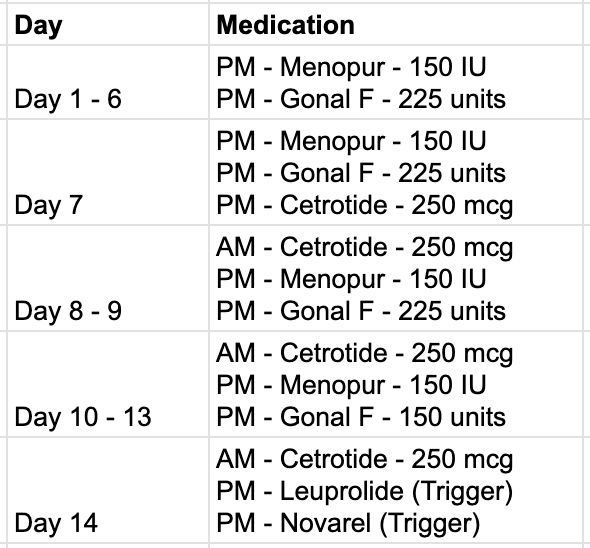
Shots and check-ins happen for the next ~2 weeks (it was 2 weeks exact for me). The # of days of shots varies based on how your body is reacting to the hormones, so you need to be in the mindset to take each day as it comes. I had a check in every ~3 days, though I heard others had more frequent checkins. These checkins always include a transvaginal ultrasound, and sometimes included bloodwork. For the first week I had 2x shots nightly (back to back) and by the second week I had 3x shots (1x in the AM, 2x in the PM).
Trigger shot occurs closer to the end of two weeks, after a check in is scheduled. A nurse called me that day with instructions to use the trigger shot medications at a very specific time, and a date/time for my egg retrieval (typically after 34-36 hrs from trigger shot). It is critical to complete the shots at that time since these shots trigger ovulation, which should in theory happen after the egg retrieval is done. If you ovulate before egg retrieval, then you lose your mature eggs since they’re released from your ovaries and make their way into your fallopian tube where they cannot be surgically retrieved. All those shots for nothing :/
Egg retrieval was scheduled on Day 14. I was advised to take the day off even though the procedure itself takes less than 30 minutes and you’re under anesthesia for it (best nap ever!). I arrived at the clinic ~1.5 hrs before the procedure time for pre-op where I measured vitals, had an IV drip for hydration, and was eventually escorted into the surgery room for anesthesia and the retrieval. I woke up in the post-op room and was told how many eggs were retrieved and shortly discharged. I took pain meds proactively to minimize cramping and I felt fine enough to take the subway back home. A few hours later, the nurse called to share the final results of how many eggs were frozen since there is a drop-off between eggs retrieved and eggs successfully frozen.
Recovery varies for people and I was told that cramping would peak in the next 3-4 days. I was also advised not to work out heavily (not even yoga) for the next two weeks and abstain from sex for the next 10 days (to avoid ovary torsion). I was lucky enough to not have complications or side effects from the surgery and didn’t experience cramping.
Medications
My medications consisted of:
Gonal F - follicle stimulating hormone (FSH) to increase egg growth
Menopur - FSH and LH to increase egg growth and estrogen production
Cetrotide - prevents early ovulation
Trigger shots - two kinds of shots to trigger ovulation
I shared my daily medication schedule below:
Where to buy: I purchased my medications via Alto Pharmacy (recommended by my benefits provider) and did not shop around to optimize meds costs. The meds are nearly as expensive as the procedure itself, so I recommend ordering them 1-2 days max before you need them to minimize waste. In total I placed 5 pharmacy orders during this time and only ended up with $200 worth of excess meds.
Symptoms
Not everyone will feel exactly the same, but here’s what I experienced…
Pain from injections - I was warned ahead of time that the menopur shot burns while it’s being injected in you. This is true, but it’s not as bad as I made it out to be. To minimize the pain, I iced my underbelly (where you inject the shots) and sprayed maximum strength lidocaine prior to injecting. I also found it more comfortable to inject myself slowly vs having my husband do my shots. This way I was able to feel the burn, take pauses, and then resume again when I was ready. Surprisingly, the Gonal F shot sometimes also hurt but this was less frequent. The Cetrotide and trigger shots were the best in that it just felt like you were poking yourself with a needle.
Bloating - Others advised that the first few days would feel like nothing and I’d feel heavier as my eggs grew. I hardly felt any bloating up until the second to last day. My hypothesis is that my egg count was relatively low even with the shots (towards the end it peaked at ~20-22 eggs) and this is equivalent to what someone with a higher egg count carries in a regular cycle anyways. I did feel some noticeable bloating after my trigger shots, however.
Exhaustion - I definitely felt more tired towards the last few days but it wasn’t much different than being down with a slight cold.
Nausea & dizziness - the one time I felt severe nausea and dizziness was right after the trigger shot. The trigger shots force a massive hormonal surge, shocking your body. I wasn’t mentally prepared to feel this which did cause me to panic a bit, but I ended up soothing myself with electrolytes, sniffing citrus, and forcing some sleep.
Moodswings - with an increase in estrogen production, I anticipated feeling more “emotional” but I had the opposite effect actually. More estrogen made me feel calmer and steady, which surprised the shit out of me considering a number of personal events had unraveled over the course of those two weeks. If I was ever going to have a crash out, then would have been the time. My doctor explained that the calming effect made total sense since estrogen increases serotonin (the happy hormone). He did warn of an estrogen come-down post procedure, but I don’t think I felt this either.
Cramping - Unfortunately I felt severe cramping on the day of my egg retrieval (akin to what I normally felt having endometriosis). It had started on my commute to the clinic and continued through pre-op. It turned out that I had started ovulating earlier than expected and my cramping was indicative of that. Once the retrieval was over, the cramping did not return and I had taken pain meds proactively to make sure of it. The following days post procedure I did not need pain meds at all, lucky me!
The costs
In total, my costs (excluding benefit) were:
Egg freezing procedure - $9,280
Meds - $8,637
Storage fees (annual) - $1,250
Since 80% of my costs were covered by my benefit, I will end up paying $3,442 out of pocket. Note that you’re expected to pay up front and then get reimbursed, so I recommend using this as an opportunity to open a credit card with a shiny welcome offer that you can instantly hit with this spend.
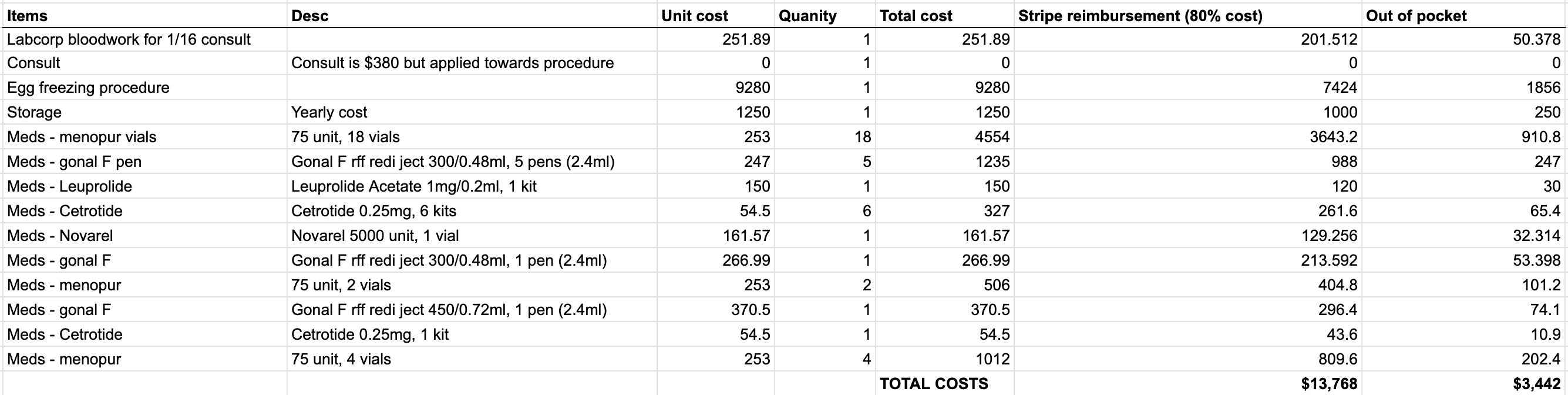
Note that embryo freezing comes with higher costs and I believe my employee benefit also unlocked more discounts with the clinic and pharmacy.
Results & takeaways
Ultimately I ended up successfully freezing 7 mature eggs, which was less than what my doctor and I expected. Since I started ovulating prematurely ahead of my retrieval, I lost >50% of my egg reserve in a matter of hours. On my last check in prior to my procedure, I had at least 22 identifiable eggs, so my doctor was expecting to retrieve ~20 eggs. Because I was reacting so well to the medication, he expected to freeze 14-15 mature eggs which would have afforded me a 93% chance for 1 child and a 73% chance for 2 children using those eggs (vs 71% for 1 child and 32% chance for 2 children).
I did not have the indicators of someone who would ovulate early (e.g. diminished ovarian reserve) so this was a surprise to my doctor and could not have been caught earlier.
Even though I did not get the results I wanted, my experience was positive enough that I would do this over again. I now have the insights to do a second round with ~hopefully~ more successful results by timing an earlier retrieval. Though I’m not scheduling this anytime soon. Considering why I did this in the first place — having a safety net for physical and psychological reasons — I achieved enough to not feel the urgency to do it twice. My doctor also advised that since I did this so early, I could probably wait up to two more years for a second round to get similar results.
I went from being terrified of shots to comfortably injecting myself 3x/daily. Believe me, I was the girl who would wear noise canceling headphones, close her eyes, and count backwards every time I needed to get blood drawn. My husband did my shots for the first 2 nights but then I found the courage to do it myself, and I was glad I took that on for myself. Injecting myself gave me a sense of control (I could go as slow or fast as I want) and a sense of pride (I can’t believe I’m doing this, look at me!).
I’m so glad I documented this. Even if you won’t post this on social, take photos and videos and save ultrasound progress reports for your own recollection. I went from 7 eggs to 10 to 17 to 22 by the time I was ready for my trigger shot. This experience has left me in awe of what we’re capable of. While my shot marks are already fading, I have dozens of photos and videos that capture the endurance it took for me (and for so many other women) to give ourselves a little more independence and a whole lot more peace of mind.
All that to say: the Year of the Horse feels especially fitting for my 2026. Bold, uncomfortable, a little wild… and completely worth it.