
The places I lived
on growing up in the NYC housing projects

I’m currently lounging poolside at the Alila Big Sur, where rooms cost over $1,000 a night. I booked it with points, but the truth is I wouldn’t have paid cash anyway. Growing up in the NYC housing projects (where monthly rent was $400) rewires your sense of what’s necessary, what’s excessive, and what you’re allowed to have.
By the time I was born, my newly single mom had sought refuge with her eldest brother. He was already living in a cramped railroad style apartment in Astoria with their parents. This apartment was supposed to be temporary (my sister, mom, and I shared a mattress that took up most of the room). She was eagerly awaiting news on an opening in one of the three local housing projects.
My mom had preferences but knew the waitlists for all of them were oversubscribed. Ravenswood was the top choice, being the safest out of the three, closest to the subway, and best maintained. Queensbridge was notorious, and for good reason — it was the source of inspiration for Nas’ NY State of Mind. Astoria Houses fell somewhere in the middle, tucked away by the riverside and more isolated, but still safer than Queensbridge.
Five years later, she got the letter. We were placed in Astoria Houses.
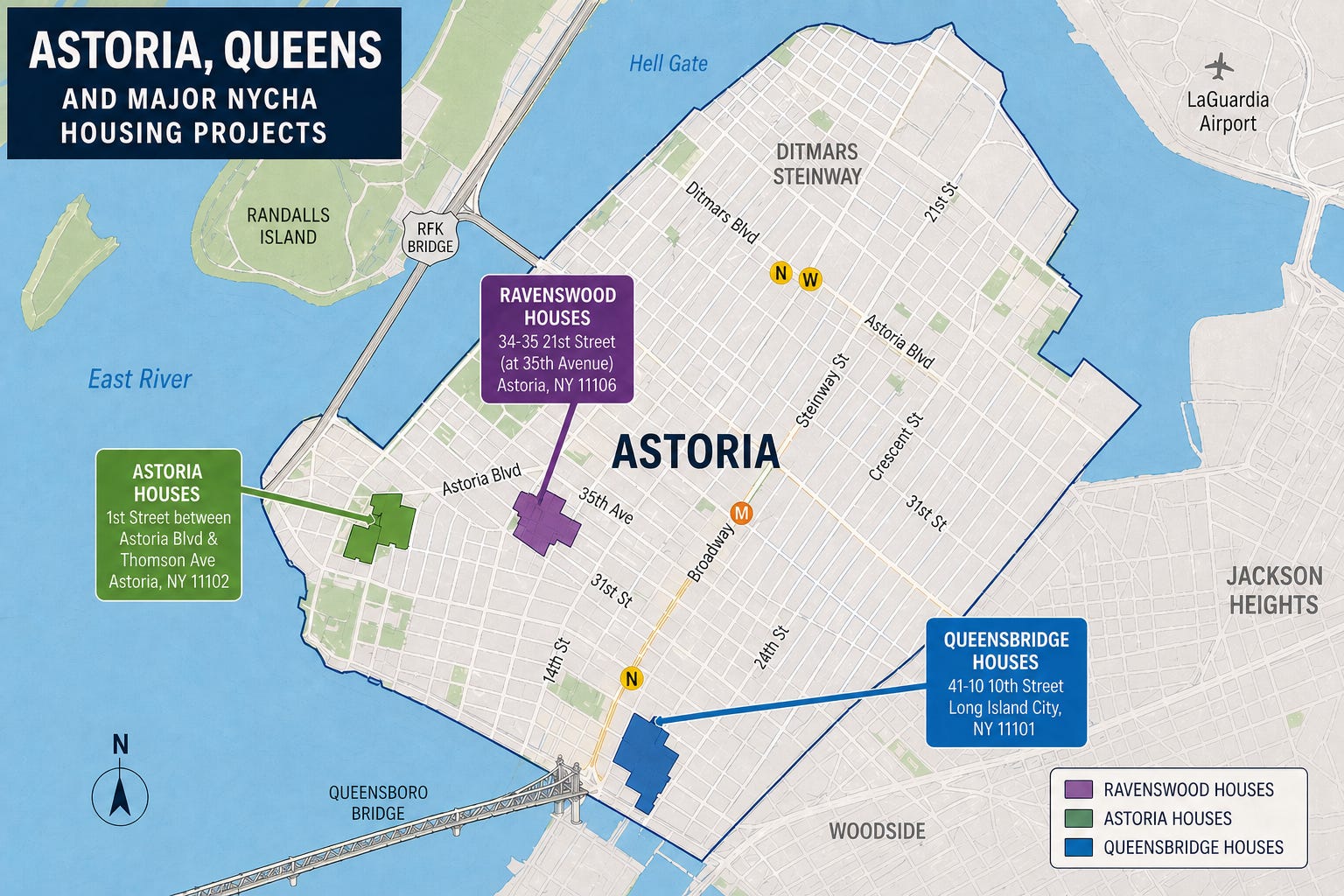
Astoria looks different now. The neighborhood that once felt unassuming and blue-collar is now filled with trendy coffee shops, restaurants, and transplants. My German coworker, J, recently mentioned he lived right across the street from my childhood home when he first moved to New York.
The last time I walked past Astoria Houses, there was a “luxury” apartment building that stood literally on the grounds of the complex, on the former parking lot. I shook my head and questioned who would pay premium market rates to live there. Then I thought about J.
The five of us (my mom, sister, grandparents, and I) were assigned a four bedroom apartment on the fifth floor of Building 6. This, we learned, was a relatively OK setup. Our neighbors didn’t pose any immediate danger. As far as I knew, they were just other families trying to get by with little. And while our building wasn’t on the edge of the complex—the most desirable location—it was a two-minute speed walk from the nearest exit.
I wish I had nicer things to say about the setup, but it stops there. Living in the projects came with an embarrassment I wouldn’t wish on anyone. It's only after you leave that you can begin to reconcile the shame.
You feel the danger the minute you enter the complex, and it’s warranted. Astoria itself is relatively safe, but Astoria Houses is not.
You become desensitized to violence and neglect because it’s so common. Dog owners hitting their pitbulls. Pregnant girls smoking cigarettes. Mothers slapping and cursing at their toddlers. Grown men, teenage boys, even girls getting into fights. Your coping mechanism is to speed up your pace and look the other way.
You roll the dice every time you ride the elevator. What’s constant is the smell of urine, sometimes mixed with cleaning bleach, sometimes mixed with Chinese fried chicken. What’s unpredictable is which floor you’ll stop and who’s stepping in with you. You learn to find the elevator buttons very interesting when the guy next to you has a glock tucked in his waistband.
When the elevator is out of service, you almost wish you had taken your chances with it instead of walking up five flights of stairs with busted lights, not enough cameras, and teenagers loitering at the base.
You learn to avoid certain nights. Fourth of July and New Year’s Eve blur the line between fireworks and gunshots. Halloween meant the masks were useful for reasons that had nothing to do with candy. These were small tradeoffs for safety, but they meant I didn’t grow up trick-or-treating or watching fireworks outside.
The buildings were in poor shape, plagued with roaches. I would turn on the bathroom light and see dozens of baby roaches scatter across the floor. I became quite good at squashing them with sandals. I once poured a bowl of chocolate Rice Krispies and found a baby roach drifting in the milk two bites in. I hadn’t even seen it. The roach infestation felt just as unsettling as the danger outside.


Hardly anyone visited. Forget friends, even certain family members wouldn’t visit. Eid felt lonely. Eventually you stop answering directly when people ask where you live. On the school bus, you ask to be dropped off a few blocks early. But what stayed with me longer than the loneliness and the shame was the feeling that I couldn't count on people to show up.
My dad was more scared for himself than for his daughters. My parents were divorced, but he tried to be there for the practical things. One Saturday night, after my friend’s Sweet 16, he drove me back home.
“Make sure he drops you right at our doorstep”, my mom warned earlier.
It was close to midnight by the time we pulled up to the edge of Astoria Houses. My dad shut the engine off and turned to me.
“Baba…your mom wants me to drop you at the door, but do you think you can go in yourself? I don’t know this place. I’m in a suit…they’ll notice me. They know you though.” he reassured me.
I wasn’t surprised. He had asked me this before. But this time felt worse—I was dressed up, alone, and it was late. I hesitated, then nodded.
“Thank you my smart daughter. Text me when you get inside and don’t tell your mother.”
I couldn’t tell if he was more scared of getting jumped by a thug or getting ripped apart by my mom, but I made sure neither happened. I threw on a cardigan to cover my dress, wiped off my lipgloss, and walked as fast as I could. I was 16 and already learning that I couldn’t depend on a man.
My autistic brother didn’t get the care he needed during his most formative years. Therapists would come once, then never return. At first, we were hopeful when someone promising showed up for a session, but it didn’t take long to understand why they stopped coming. I still think about how much more his condition would have improved if we had lived somewhere else.
I became hypervigilant and socially aware at an early age, but at the cost of always being “on”. Nothing truly bad ever happened to me in the projects. I didn’t get robbed, raped, or physically hurt — I credit that to survival tactics which I kept a mental tab on:
“Take your headphones off when walking into the complex so you can hear your surroundings.”
“Walk from point A to point B extremely fast.”
“Fake fearlessness and move confidently.”
“Gently smile at the drunk guy in the lobby so he doesn’t target you, but don’t overdo the smile or else he will target you.”
“Let the drunk guy walk into the elevator first, and then politely tell him you’ll catch the next one.”
Even now, my brain is always scanning and reminding. It’s hard to relax. When I’m not looking for threats, I’m running through tasks and logistics to feel productive. I stopped wearing an oura ring because it told me I was always stressed. Just yesterday I tried reading in a parked car in the middle of the redwoods. Five minutes in I glanced at the side mirror to make sure a serial killer doesn’t come out of the woods.
Growing up, I knew I wanted to get out of the projects, but my ambitions were anchored to my starting point. When I was younger, I daydreamed about how lucky we’d be if we got approved for a transfer to Ravenswood Houses. In high school, I envisioned my life with a condo in Forest Hills, Queens and a Volkswagen Beetle. I was genuinely content with the idea of that. It wasn’t until I surrounded myself with more ambitious people that my sense of what’s achievable expanded. The type A in me wonders how much faster I might have gone if I had known earlier what I was actually capable of.
I still carry some resentment toward my mom for keeping us there longer than we needed to be. I understand why she turned to the projects in the beginning—she had just started working and didn’t have much saved. But later on, staying there was more of a choice than a circumstance.
We could have downsized and lived somewhere smaller but safer, like many of my friends’ families did. Instead, there were other priorities, like gifting $3,000 for a relative’s wedding or buying my sister a Canada Goose jacket.
What I still don't understand is why a safe home didn't come first. My mom attracted the male gaze easily and she had two little girls by her side. Maybe she felt so far from that goal that she chose smaller, more immediate wins.
Eventually, I took over managing her savings, and she was able to buy a house and move out. At this point in our lives, with both of us past the projects and an otherwise healthy relationship, I’m not quite sure what to do with the resentment that remains. It exists, and I just let it sit there.


I live in a different riverside apartment now. This one is a high-rise doorman building in Williamsburg, less than 10 miles south of Astoria Houses. The penthouse apartment is over 15x the rent of what my family used to pay, which is jarring, but I’ve decided I’m allowed it.
There are four pristine elevators and no roaches, and on New Years Eve I go up to the rooftop and watch the fireworks dance in the sky.


